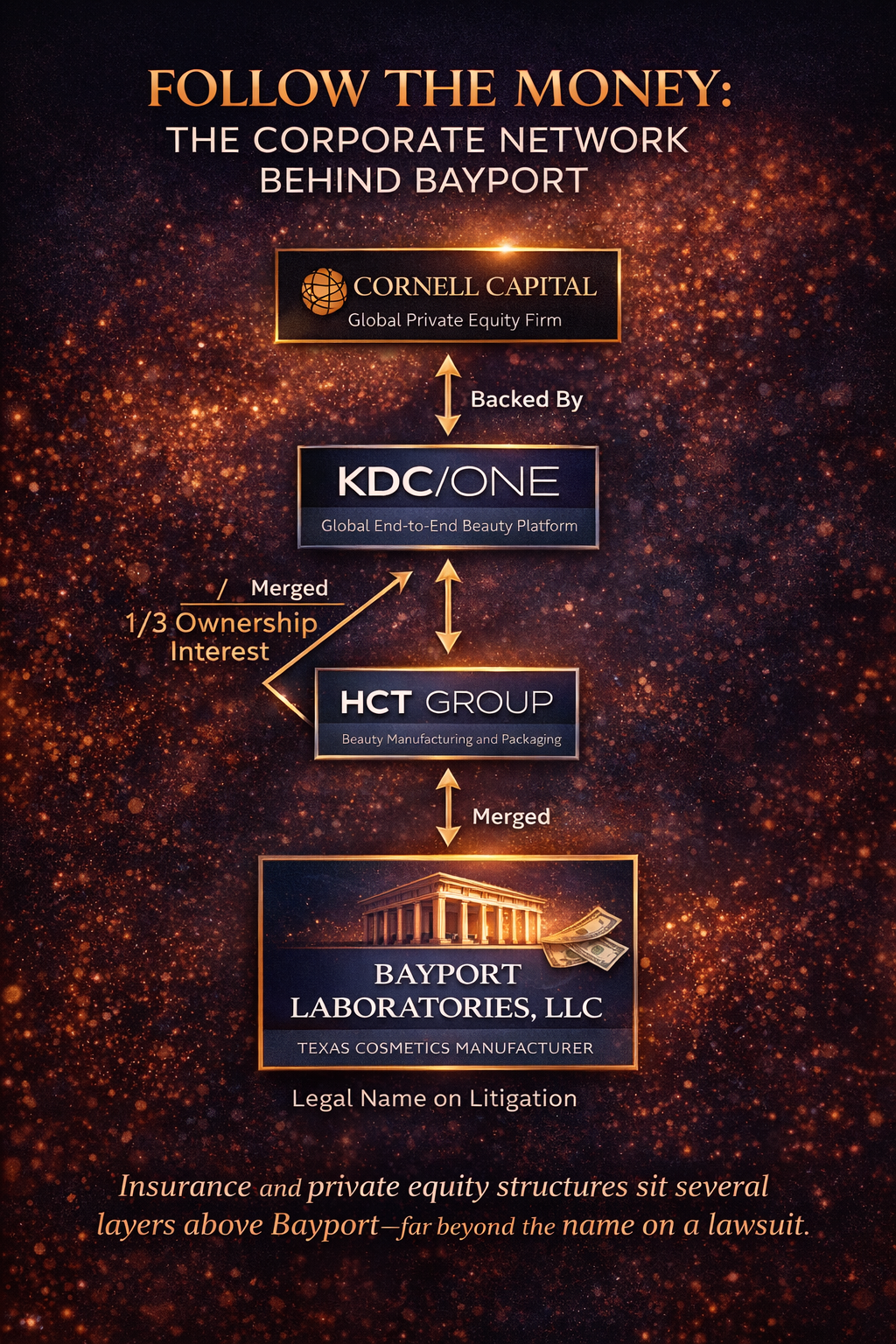

Follow the Money: The Corporate Network Behind Bayport (HCT, KDC/ONE, Cornell Capital)
When a litigation story doesn’t add up on the surface—aggressive filings, high-stakes damages claims, emergency relief, and shifting narratives—the fastest way to understand it is to follow the money.
In Bayport’s case, public records point to something larger than a standalone Houston manufacturer. The corporate ecosystem behind Bayport includes HCT, KDC/ONE, and Cornell Capital—entities tied to the global beauty supply chain and large-scale private equity-backed consolidation.
This matters because corporate structure affects everything:
who has leverage,
who bears reputational risk,
who actually benefits from delay,
and why a case can be litigated like a war while decision-makers stay offstage.
Executive Summary (Plain English)
Public filings and deal announcements support the following chain:
Bayport Laboratories, LLC
⬆ (partial ownership interest)
HCT Group
⬆ (merged into / combined with)
KDC/ONE
⬆ (backed by / tied to)
Cornell Capital
This is not conjecture. The most direct statement is in an SEC filing that identifies Bayport as an entity in which HCT held a one-third ownership interest.
1) The Key Receipt: HCT’s One-Third Ownership Interest in Bayport
The cleanest “follow the money” fact is not in a blog post or rumor mill. It’s in an SEC registration statement that describes related-party transactions and explicitly notes:
purchases from Bayport Laboratories, LLC, “of which HCT has a one-third ownership interest.”
That single sentence is the hinge.
It means Bayport is not just an isolated operating company. At minimum, Bayport has been positioned within a broader packaging/manufacturing ecosystem where HCT held equity.
2) HCT → KDC/ONE: The Consolidation Move
Next step: HCT’s merger with KDC/ONE.
Multiple credible transaction sources confirm that KDC/ONE merged with HCT Group, creating an end-to-end beauty solutions platform.
PR Newswire announced the merger and described KDC/ONE’s growth strategy through acquisitions.
Houlihan Lokey’s transaction page confirms the merger and states it closed January 23, 2020, and identifies KDC/ONE as a Cornell Capital portfolio company.
Industry trade coverage similarly describes the merger as building global end-to-end capabilities.
This matters because if HCT sits above (or alongside) Bayport via a one-third ownership interest, and HCT is combined into a larger platform, then Bayport’s litigation footprint and operational role are not happening in a vacuum.
3) KDC/ONE ↔ Cornell Capital: The Money Layer
KDC/ONE’s ownership/financing history is also documented in SEC materials, including language describing Cornell’s role in establishing the holding structure and transferring ownership interests around the acquisition framework.
And independent transaction sources describe KDC/ONE as Cornell Capital-backed, including in connection with the HCT merger.
This is the private equity layer. It’s not “good” or “bad” by itself—but it is relevant because it introduces predictable incentives:
risk management
reputational containment
legal spend controls
settlement authority bottlenecks
aggressive posture at the operating-company level while the capital layer stays insulated
4) Why This Makes Bayport’s Litigation Posture Harder to Defend Publicly
Here is where Bayport starts looking strategically exposed (not “foolish” as an insult—foolish as in internally inconsistent).
If Bayport is connected upstream to a sophisticated platform (HCT/KDC/ONE) and capital sponsors (Cornell), then the litigation narrative of:
catastrophic damages, existential harm, emergency relief, and scorched-earth tactics
while simultaneouslyminimizing or obscuring coverage/indemnity realities (where applicable)
creates a credibility problem—because sophisticated enterprises are expected to have:
documented governance,
structured risk transfer,
compliance processes,
and clean financial narratives.
When the public record later reveals corporate linkages and financial sophistication, the “small victim company” posture becomes harder to square.
In plain terms: the more sophisticated the network behind Bayport, the less believable “confusion” becomes—especially on insurance, disclosure, and authority.
5) The Practical Takeaway: Who Has Power, Who Has Exposure
This network suggests a classic split:
Who has the exposure?
Bayport (the operating company name on the pleadings)
Who often has the power?
Upstream platforms and capital layers (HCT/KDC/ONE and their financial sponsors)
Insurers and claims decision-makers (if coverage applies)
Who often acts as the conduit?
Defense counsel (whose authority commonly depends on carrier or internal approvals)
That is exactly why the public feels lawsuits like this are “rigged”: the visible actor is not always the controlling actor.
6) The Questions That Now Write Themselves
Based on the documented relationships above, the questions a reasonable reader (or reporter, regulator, or judge) will ask include:
What is Bayport’s current equity/affiliate structure relative to HCT/KDC/ONE (if any remains)?
What risk-transfer mechanisms exist (insurance, indemnities, management agreements), and when were they disclosed?
Who controls settlement authority in practice—operating management, carrier, or upstream stakeholders?
How were damages quantified, and do they align with upstream transaction sophistication?
These questions are not “internet drama.” They are standard diligence questions in any high-stakes commercial dispute.
One-Line Summary
If HCT held a one-third ownership interest in Bayport (SEC), and HCT merged into Cornell-backed KDC/ONE (deal announcements), then Bayport’s litigation conduct is happening inside a much larger corporate and financial ecosystem—and the public record makes any inconsistent narrative increasingly difficult to defend